
In industrial production, heat exchange equipment is like the human circulatory system, carrying the task of energy transfer. Among them, the shell-and-tube heat exchanger — the most widely used conventional type — has been the first choice of the process industries for decades.
In recent years, however, as the dual-carbon goals take hold and competition intensifies, users’ need for energy saving and carbon reduction has become urgent. In industrial waste heat recovery, a new solution is standing out — the fully welded plate heat exchanger. But how does it achieve a 30% improvement in heat transfer efficiency?
The conventional exchanger’s dilemma: stable but inefficient
The shell-and-tube heat exchanger has held its dominant position thanks to extremely wide duty adaptability: from –196 °C low-temperature refrigeration to 1,200 °C high-temperature waste heat recovery, from vacuum to tens of MPa and above, it runs stably.
Behind that stability, however, lies enormous energy waste. According to the US Department of Energy, heat discharge from industry accounts for more than 20% of total global energy consumption — and in China the proportion is even more striking.
For an enterprise, wasted waste heat converts directly into lost money: for every 10% drop in heat transfer efficiency, annual energy cost can rise by hundreds of thousands, even tens of millions of yuan. With energy prices climbing, the efficiency ceiling of conventional exchangers has become a major obstacle to corporate development.
The efficiency revolution: four breakthroughs of the Nexson fully welded plate heat exchanger
Compared with shell-and-tube units, the fully welded plate heat exchanger is not a simple substitute but a precise upgrade aimed at that efficiency ceiling:
1. Multiplied heat transfer efficiency: effective heat transfer area per unit volume in a conventional shell-and-tube unit is only 20–100 m²/m³, while a fully welded plate unit — built from stacked corrugated metal plates welded together — reaches 250–1,000 m²/m³, an increase of 5 to 20 times. The corrugated channels force the fluid into intense turbulence, raising the heat transfer coefficient substantially.
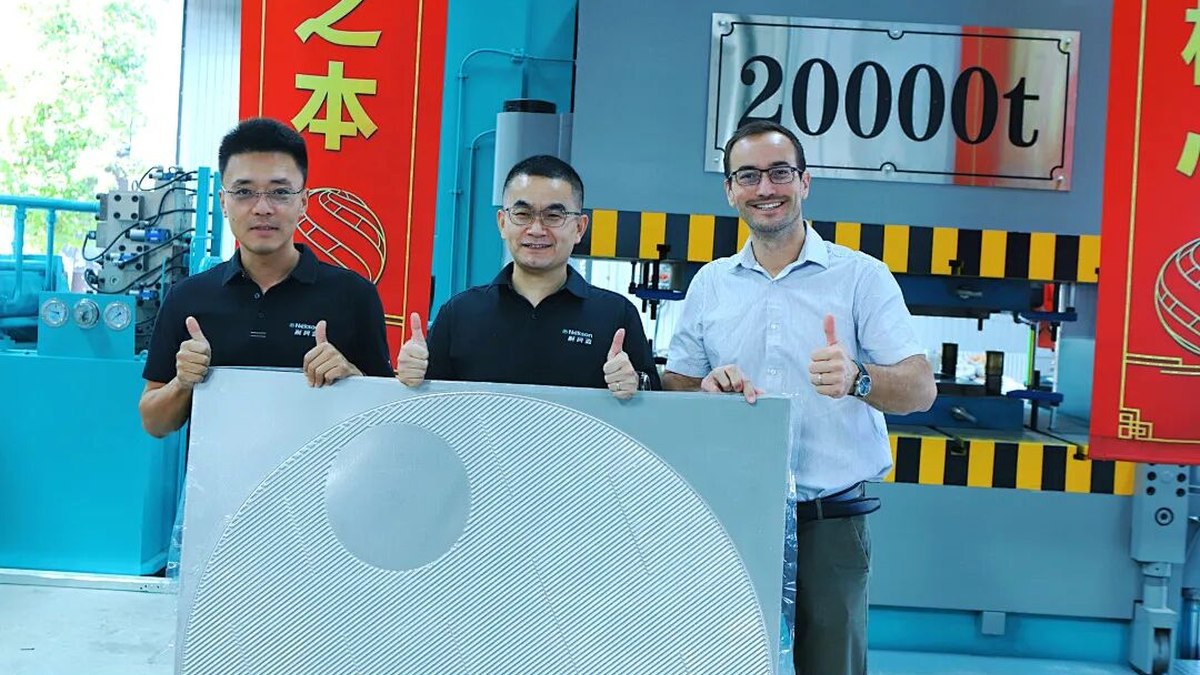
2. Wider extreme-duty adaptability: plates are joined by fully automatic argon arc welding into an all-welded structure that abandons rubber gaskets entirely. The temperature range widens to –196 °C to 500 °C and design pressure reaches 20 MPa, greatly expanding the application field. It runs efficiently and stably even under high temperature, high pressure and strongly corrosive duties.
3. Much lower operating and maintenance cost: conventional shell-and-tube units foul more readily and need regular shutdowns for cleaning. The smooth plates and turbulent design of a fully welded plate unit suppress scale formation, extending cleaning intervals several-fold and cutting operating cost substantially.
4. Less space: for the same heat duty, a fully welded plate unit occupies only one third to one fifth of the volume of a shell-and-tube unit and weighs 60% less. This is especially helpful on retrofit sites where space is tight and reinforcement is difficult — civil works cost can even drop by 60%–80%.
Real case: helping a company achieve 30% higher efficiency
A waste heat recovery retrofit on the H₂S removal unit of a German industrial enterprise provides strong proof of what fully welded plate heat exchangers can do.
Amine gas treatment is a widely used process for removing impurity components such as H₂S or CO₂ from gas. The process usually consists of two columns and four core heat exchangers: an absorber and a regenerator, plus a reboiler, a lean/rich amine exchanger, a lean amine cooler and an overhead condenser.
As the diagram shows, the process needs two kinds of external energy: steam for the reboiler, and a cooling water circulation system or air for the lean amine cooler. Both represent operating cost. Under the original conventional scheme, the reboiler and lean amine cooler were shell-and-tube units.
The operating conditions were as follows: rich amine 122 °C → 78 °C; lean amine 48 °C → 92 °C. Total heat recovered: 3.4 MW. That means 2.2 MW of energy lost — extra steam needed on one side to raise the lean amine temperature, and heat dumped to air on the other to lower the rich amine temperature.
After switching to the Nexson GreenBox fully welded plate heat exchanger, the operating conditions improved to: rich amine 122 °C → 65 °C; lean amine 48 °C → 105 °C. Total heat recovered: 4.4 MW, with energy loss down to 1.2 MW.
Before the retrofit, the shell-and-tube units recovered only 3.4 MW per hour while 2.2 MW was lost directly to incomplete heat exchange — a waste heat recovery efficiency of just 60.7%. After the switch to fully welded plate units, recovery efficiency rose from 60.7% to 78.6%, a relative improvement of 30%.
On 8,000 hours of continuous production a year, the retrofit recovers an extra 8,000 MWh of heat annually — equivalent to saving 290 tonnes of standard coal and cutting CO₂ emissions by about 770 tonnes, delivering both economic and environmental returns.
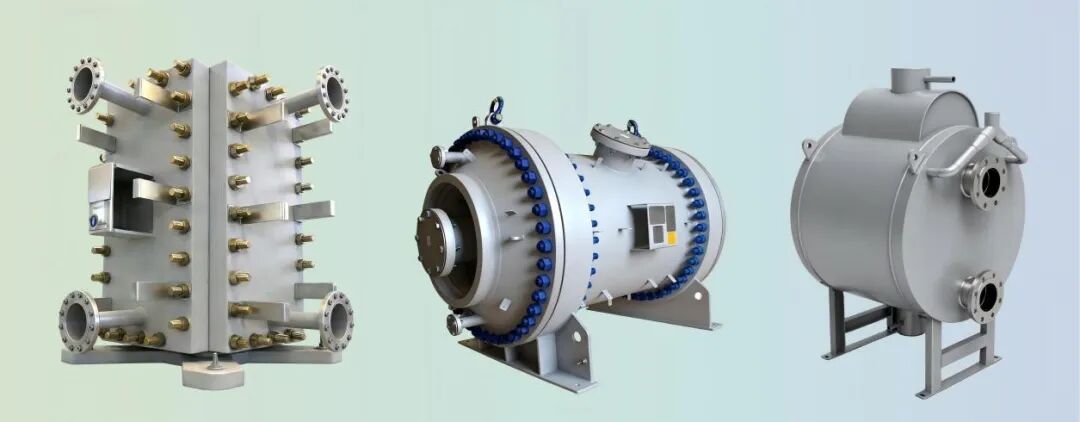
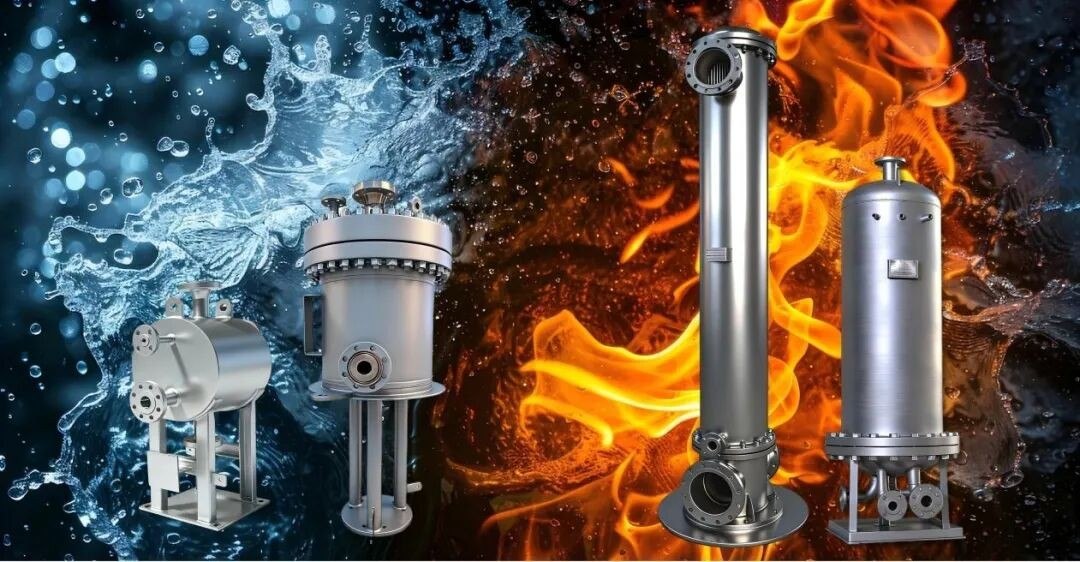
As a leading brand in fully welded plate heat exchangers, Nexson has built a comprehensive product range for the duty requirements of different industries, covering spiral plate heat exchangers, fully welded plate heat exchangers and fully welded plate-and-shell heat exchangers.
Whether for high-pressure, high-temperature scenarios in oil and gas, refining, heavy chemicals and new energy, or for fields with high cleanliness requirements such as food and pharmaceuticals, Nexson Group can provide a professional one-stop heat exchange solution — from equipment selection and installation through commissioning to later operation and maintenance — keeping heat transfer efficiency stable and on target throughout.
In closing
Against the dual-carbon goals, efficient use of industrial waste heat has become a core route for companies to cut cost and raise efficiency. Upgrading from conventional shell-and-tube units to fully welded plate heat exchangers is not only the inevitable trend of technology iteration but a wise choice for companies pursuing green transformation.
A 30% improvement in heat transfer efficiency is no longer a theoretical possibility — it is happening now. For companies that want to take the lead in a fierce market, embracing this technology change may well be an important step towards high-quality development.